

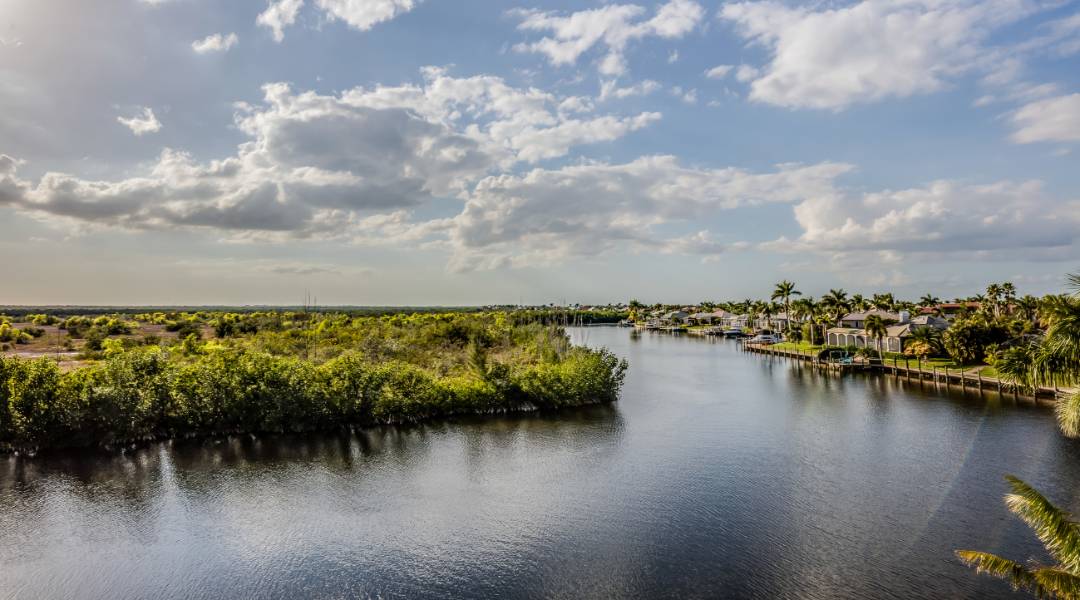
Buying a waterfront home in Southwest Florida sounds simple—until you’re actually doing it.
On paper, “waterfront” looks the same everywhere. In real life, it can mean five minutes to the river or an hour and twenty minutes of idling, bridges, and shallow canals before you ever see open water. I’ve seen more buyers get surprised by that than just about anything else.
So let’s slow this down and talk through how to actually choose the right waterfront home—based on how you live, how you boat, and what you want your days to look like once you’re here.
This is the stuff you don’t learn from listing photos.
Not All Waterfront Is Created Equal
One of the first things I tell buyers is this: “Waterfront” is not one category.
In Southwest Florida, you’ll see very different types of waterfront properties, including:
-
Gulf-front homes
-
Riverfront properties
-
Canal-access homes
-
Direct Gulf-access vs. indirect access
-
Sailboat-access canals
-
Freshwater canals and lakes
-
Golf-front homes that look like waterfront but don’t connect to navigable water
I see this most often with buyers looking online—especially in places like Cape Coral. Some canals connect to saltwater and the river. Others don’t. And sometimes buyers aren’t told the difference.
That’s not a small detail. That’s the whole deal.
If boating is part of your lifestyle, you need to know exactly where that water goes.
The Question I Always Ask First: How Do You Plan to Use the Boat?
Before we ever talk about price, bedrooms, or finishes, I want to know one thing:
What’s your boating application?
That sounds technical, but it’s simple:
-
Are you an offshore fisherman?
-
Do you want a 50-foot sportfish or a cabin cruiser?
-
Are you a back-bay fisherman running skinny water?
-
Do you plan to cruise to restaurants, islands, and beaches?
-
Or are you someone who will eventually own two boats—one big, one small?
Because here’s the truth: The house that fits your boat is often more important than the house that looks pretty from the street.
A Real Conversation I Have All the Time (And One That Saved a Buyer a Fortune)
I’ll never forget a conversation with friends of mine—Jim and Michelle.
They were looking at beautiful, newer homes online. Big front elevations. High ceilings. Everything shiny and new. And they couldn’t understand why the homes I was sending them looked more modest for the same price.
So I asked Jim a question he still laughs about to this day:
“How many beers do you want to drink before you get to the river?”
He said, “What?”
I explained it like this:
Those big, beautiful homes he loved were an hour-plus boat ride to the river, with bridges—and the boat he wanted wouldn’t even fit under them.
The homes closer to the river? The dirt costs more. The houses aren’t always as flashy. But you’re two to five minutes to open water.
Long story short:
He bought a home on a basin, two minutes to the river. Years later, after remodeling, he sold it for almost double what he paid—and then bought another home, even closer.
That decision changed their entire experience living here.
Location, Dirt Value, and Why It Matters
Here’s something buyers don’t always realize:
-
The closer you are to the river or Gulf, the more valuable the dirt
-
Homes farther inland can be newer and larger—but the commute by water is longer
-
Waterfront value isn’t just about the house; it’s about access and time
That’s why neighborhoods like:
-
Town & River
command higher prices for smaller or older homes—they’re close to the river.
Dockage: The Thing Most Buyers Don’t Think About (Until It’s Too Late)
I can’t stress this enough:
Know your dockage.
Ask yourself:
-
How much waterfront frontage do I have?
-
Can it accommodate one boat—or two?
-
Do I have room for lifts, pilings, and setbacks?
-
Will my boat fit at low tide?
I’ve had buyers fall in love with a home—then realize they only had 40 feet of frontage, and they wanted two boats. That doesn’t work.
Seawalls: Inspect Them. Always.
Seawalls are not optional maintenance. They are structural—and expensive.
Here’s what I look for:
-
Old corrugated (asbestos-era) seawalls → failing
-
Leaning seawalls → pressure behind the wall
-
Cracked caps or exposed rebar (spalling) → red flags
Today’s replacement costs can range from $700 to $1,100 per linear foot.
Do the math on 80 feet of seawall.
That’s why I always recommend a seawall inspection before you close.
Depth, Tides, and Why Southwest Florida Isn’t Like the Midwest
Many buyers come from freshwater states where:
-
No tides
-
No draft concerns
-
If the boat fits, it fits
Southwest Florida doesn’t work that way.
Your boat might float fine at 2:00 PM—and be hard aground at 6:00 PM.
You need to understand:
-
Tidal swings
-
Mean low water vs. high tide
-
Channel markers
-
Draft vs. lift clearance
Some days, even I move my boat off the lift and park it differently because I know how low the tide is going to drop.
That’s just part of waterfront living here.
If You’re Not Sure, I’ll Show You
The hardest part for many buyers is this:
You don’t know the lifestyle until you live it.
That’s why I often say:
“Let’s get in my boat, and I’ll show you the lifestyle.”
Once you experience the run, the idle time, the bridges, the tide changes—it all clicks.
And when it clicks, you make better decisions.
Final Thought: Waterfront Done Right Is a Game Changer
Buying a waterfront home in Southwest Florida can be incredible—or frustrating—depending on how well it matches your lifestyle.
The key is asking the right questions before you fall in love with the wrong house.
If you’re thinking about buying a waterfront home in Southwest Florida and want to make sure it truly fits your lifestyle—not just looks good online—I’m happy to help. Tell me what kind of boating you enjoy, the type of boat you have (or plan to have), and how you picture spending your time on the water. From there, we can narrow in on the right neighborhoods and properties that actually work for you.
Contact Shane “Waterfront” Wilson to start the conversation


